
Magic of the Land – How Folklore and Mythology Shape Culture
By Dasha Kurbatova, 19th May 2026
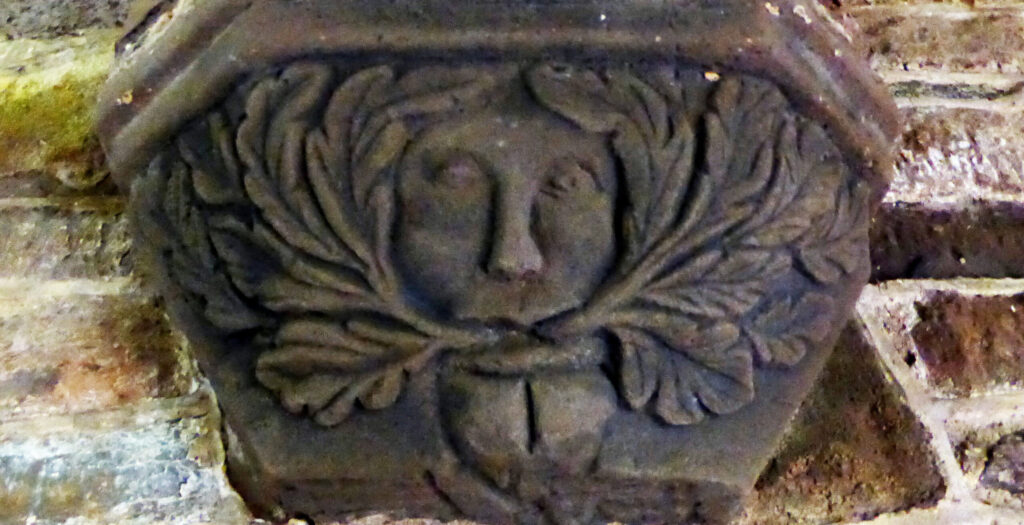
The foliate head noticed by Lady Raglan in Llangwm, Wales, and dubbed a “Green Man” in about 1931. Photo by John Lord, 2014. Shared to Flickr with a Creative Commons license. Find the original here.
Myth is the very start of human understanding, the beginning of explanations for us and the world around us. Differing mythologies span the globe, they affect the worldview of the people brought up with them, they create culture and religion, they influence language, art, philosophy, they birth identity. The mythology and folklore of any given region are integral to understanding its people and should continue to evolve into the modern day. However, oral tradition and literary intrigue in the age of digital dependency is declining, we seldom view mythology as an important factor of society, the world does not seem so magical to us as it did to our ancestors. Even with the advent of science, with enlightenment and explanations for the world around us, I believe storytelling is still important, it is poetry reaped from the ground we walk on. Myth is fun and community building, it helps us feel connected to nature and each other, these are the things that can make us happy. Today, I want to go over some English folktales, diving deeper into their origins, meanings and their place in the modern world.
Chapter 1. You know him, you love him – its… Robin Hood!
Robin Hood is an example of a popular and enduring folktale. Everyone in Nottingham and most in England know of this legendary character, but who actually is he and what relevance does he have now?
Robin Hood is not a singular person but really an amalgamation of many people and ideas over the centuries that he’s been around for. His essence first appeared in the Middle Ages in France, slowly travelled to England and was infused with pagan ideology (notably the Green Man and May Day celebrations). He became a metaphor for rebellion, an underdog fighting against the system and for the working-class people of his time – a hero. This trope is still seen in media today, as the divide between rich and poor is as prevalent now as it was in Robin Hood’s time, this myth has endured for centuries and will continue for as long as there is such a divide.
Robin Hood is the face of Nottingham and still shapes the identity of the city – as a rebellious and anti–authoritarian force. There are statues and place names in his honour, the major oak is protected as a heritage cite, the tree under which Robin Hood and his merry men camped. Maid Marion Way, a street in Nottingham, is named after his lover, Maid Marion (also a somewhat fuzzy figure made up of many faces, notably the May Queen from the same pagan May Day celebrations as Robin himself). The memory of Robin Hood’s tale brings together community, history, religious practices and nature, carrying these things into the modern world, it seems Nottingham and Robin Hood will stay inseparable and intertwined for the foreseeable future.
Chapter 2. The Boggarts of York and Lanc
The hobgoblin or boggart is a popular creature found across Yorkshire and Lancashire (although its origin is debated and similar creatures can be found all over England, Wales, Ireland and Scotland). NOTE: I will be referring to the boggarts of Yorkshire and Lancashire for the rest of this section as characteristics across all of their many depictions may vary greatly.
Even under this limited geographical definition, the tales of the boggart are wildly inconsistent, and they range from mischievous but ultimately helpful or benign creatures to monsters with evil intentions. In a lot of stories, they are depicted as small, hairy humanoid beings, most of them are at least very naughty, if not outright sinister, and they usually live in the country, on farms, under bridges, in the woods or in caves. They were once very feared in Lancashire, with warnings that getting lost in the wilderness meant a greater probability of succumbing to a boggart’s tricks. Across Lancashire and Yorkshire there are many sites that are named after popular folktales surrounding boggarts and hobgoblins (e.g. Boggarts Bridge in Towneley Park, Burnley or Boggart Hole Clough in Manchester). These places sometimes become tourist destinations or heritage sites and can hold significance to their region’s history and culture. However, because the boggart is not well defined it is often confused or merged with other mythological creatures, it is not very well understood in the modern world and its place as a recurring folktale is uncertain.
Furthermore, some folklore scholars worry that the commercialisation of folklore has a negative impact on it as whole, tainting the original tales and boiling them down to uncomplicated shells of their former selves. When the only reason a folktale is utilised is to sell you something it’s not really even a tale, is it? It becomes a marketing strategy, using nostalgia and a vague, distorted sense of place to bring in consumers not community.
Although, usually, even with an emphasis on consumerism, if the folktale survives and more people learn about it, is this really a bad thing? Other folklore scholars argue that this tactical approach to folklore, adopting it for use in tourism or consumerism, can ensure that folktales live on in the modern world. Traditions and images related to folklore become known to a wider audience, using the boggart, for example, depictions of this creature in modern life continues; There are beers named after them, places that refer to them, people who write modern day stories which include them. The Boggart can hopefully continue to reside in the minds of English folk, in the homes of those in rural Yorkshire and Lancashire and in the modern creations which reference them.
Chapter 3. A Big Green Man in my Church?
The ‘Green Man’ (previously mentioned as one of the influences for the modern-day Robin Hood) is a complicated, heavily debated figure. He was first mentioned and categorised as a single, recurring entity by Lady Raglan in her article “The ‘Green Man’ in Church Architecture”, 1939. She noticed that the ‘Green Man’ was most often found across the midlands, in places once very rural and close to vast expanses of nature. There are many theories of how the modern known Green Man came to be, perhaps he was once a celebrated pagan figure, representing the natural landscape, the spirit of land, trees and leaves (as Raglan suggests). He could have been celebrated during the May Day festivities alongside the May Queen and other spirits/ gods related to the land.
Even after the Christianisation of England, pagan rituals and traditions survived, and we find reference to this time and time again. The image of the Green Man, normally an older man’s face with leaves sprouting from his features, appears in churches across England. He also commonly appears in one of England’s oldest institutions – pubs. All the depictions of him share in their themes of nature and well, greenery. Although, there are other theories as to why he so frequently adorns the walls of our pubs and churches; he may have been representative of Christ – a figure connected to nature, sometimes depicted, at the start of Christianity, adorned by foliage. The most probable answer is that the Green Man is a little bit of both, a mixture of different tales and characters resulting in an unclearly defined symbol for nature and English folklore today.
The Green man is an interesting figure, as he is commonly believed to be ancient but the idea of him as a pagan deity is relatively modern. He was however, depicted in churches and pubs for centuries, tracing back to the early Middle Ages, so he is in a sense both ancient and modern. There is no consensus on what ‘he’ really is, any man growing foliage can become him, this opens many possibilities for modern folktales to be told about him – something that has and continues to happen. He occurs in modern art, in poetry, in fiction and more, an imagined old folktale, malleable and celebrated now as it once could have been. ‘“I am thought of all plants” says the Green Man […] “I rise with the sap” says he […] “I am honey of love” says the Green Man’ – William Anderson, Green Man: archetype of our oneness with the Earth, 1990
Epilogue. – The future of folklore
Folklore is still being told and reimagined in modern England; it has changed and been reshaped but we will forever feel its ancient breath in many sites across this land. Some myths have endured for centuries, some have been forgotten and some have been forged anew. As we have seen from the albeit limited examples above, mythologies affect the region that they come from, they shape identity, they shape culture, they influence our outlook on life.
Robin Hood reminds us to be rebellious, to take from the rich and give to the poor, he is alive. The boggart reminds us of all the faerie and goblin spirits that once roamed our countryside and thedeceptive power of our land, they are alive. The Green Man reminds us of our pagan heritage, of our connection to nature and of its importance, he is alive in both his infancy and old age. I hope that their significance is not lost in the modern day, I hope we keep telling each other stories, old and new. Myth is the soul of the country, and I hope we can continue to have one.
Where can YOU experience old and modern folklore? – I am currently working on a project in which I create my own mythology surrounding both natural and manmade modern things. I am writing down tales which I develop with those around me and creating a catalogue of them alongside drawings in a handmade sketchbook. The project is in its very early stages and may not be
completed for a while, but you can follow along with it on my Instagram – @daria_collection
Dasha Kurbatova
Member of Pending Collective at BACKLIT Gallery
Sources Referenced
Burton-Hargreaves, A. (2025, 10). Unnatural Histories; Burnley’s Boggarts. Retrieved from Northwest
Nature and History: https://northwestnatureandhistory.co.uk/2025/10/20/unnatural-histories-burnleys-boggarts/
Castelow, E. (n.d.). The Green Man. Historic UK, All.
Ellin, B. (2020). Yorkshire hobgoblins. Hello Yorkshire, All.
Houlbrook, C. (2017). The Suburban Boggart. Sussex Centre for Folklore, Fairy Tales and Fantasy, 24-28.
Turpin, M. (2022). Where IS Robin Hood? Nottingham City of Literature , All.
Twiby, L. (2024, 03 24). Myths, Legends, Religion, and Faith: The Green Man. Retrieved from Lewis
Twiby’s Past and Present: https://lewisrhystwiby.wordpress.com/2024/03/24/myths-legends-religion-and-faith-the-green-man/
Images
The foliate head noticed by Lady Raglan in Llangwm, Wales, and dubbed a “Green Man” in about 1931. Photo by John Lord, 2014. Shared to Flickr with a Creative Commons license. Find the original here.
Fig. 24: Cathédrale de Bayeux (F), frieze on the south wall of the nave, sourced from https://www.visit-a-church.info/index.php?id=42&L=1
To find opportunities and events for young creatives in Nottingham, follow @connectingnotts on Instagram or join our Creative Futures Network.